

- digital transformation
- SME
- method
- process
Digitising an SME: where to actually start
Digital transformation rarely fails for lack of tools. It fails because it starts at the wrong end. Here is the order that works.
“We need to go digital.” The sentence comes up in every board meeting, and it is almost always followed by the same move: buying software. Six months later the licence is paid, nobody uses it, and the handwritten notebook is still on the counter.
This is not a tooling problem. It is an ordering problem. Here is the order that works, in the companies we support.
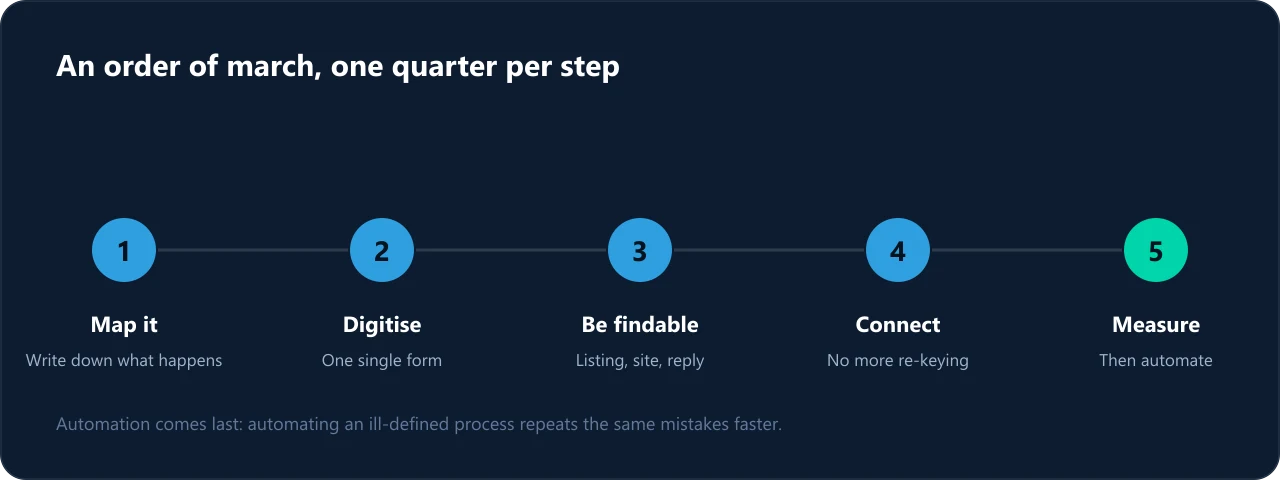
Step 1 — Write down what actually happens
Before buying anything, spend a week recording the journey of one order, from the customer's request to the payment. Who receives it, on what medium, who passes it on, where it waits, where it gets lost.
The exercise looks trivial. It almost always reveals two or three places where information is re-keyed identically, and one place where it regularly disappears. Those are your priorities. They are not the ones you would have guessed.
The simple test: ask three people to describe the same procedure. Three different answers mean you do not need software first — you need a decision.
Step 2 — Remove paper where it costs the most
Not everywhere: where it costs. Paper is not a problem in itself. It becomes one when it has to be searched for, re-typed, or when losing it stops the work.
Start with a single form — the delivery note, the service report, the leave request — and make it live digitally end to end. One. Finished, used daily, and adopted by the team. That first visible success is what makes the second project possible.
Step 3 — Be findable, and reachable
Your customers look for you on a phone. Three things matter, in this order:
- An up-to-date business listing — hours, address, phone. It is free, it shows first, and it is the most frequently out of date.
- A site that loads fast on an average connection. A beautiful site that takes eight seconds is a site nobody sees.
- A channel someone actually watches. An address displayed but never read does more damage than no address at all.
Step 4 — Connect what already exists
Most SMEs already have the pieces: a stock spreadsheet, an order book, invoicing software, a till. The immediate gain does not come from replacing them, but from wiring them together.
When an order placed on the site decrements stock, notifies the workshop and feeds invoicing, you have removed two re-keyings and one source of error — without changing a single one of your tools.
Replacing a tool everybody masters with a “better” one nobody knows is the most reliable way to make a digitisation project fail.
Step 5 — Measure, then automate
Automation comes last, and only on what is already stable and measured. Automating an ill-defined process means making the same mistakes faster and at greater scale.
Once your data is clean, the same questions finally get numeric answers: which product sells, what delivery time you actually hold, when in the week your team is overloaded.
What to refuse
- The all-in-one solution. It does everything by halves, costs a lot, and migrating off it is a project in itself.
- The vendor who keeps the credentials. Domain, hosting, accounts: all in your name, from day one.
- The eighteen-month project. Cut it up. Shipping every two months teaches you more than a hundred-page specification.
- One-shot training. A three-hour demo does not replace three one-hour visits during the first month of real use.
An order of march, not a catalogue
| Quarter | Goal | Sign it worked |
|---|---|---|
| 1 | Map it, pick one process | Three people describe the same procedure the same way |
| 2 | Digitise that process, become findable | The paper form is no longer printed |
| 3 | Connect the existing tools | No data is entered twice any more |
| 4 | Measure, then automate one repetitive task | You steer on figures, not impressions |
How long, how much
Less than feared for the first three steps — they rest mostly on decisions and internal time. Budget arrives at step four, when the links between your tools have to be built. That is also when return becomes measurable, which makes the spend defensible to a partner or a lender.
The IT Advisory & Digital Transformation page describes how we run this scoping. If you are at step one and mapping feels insurmountable, let's talk: it is usually a half-day workshop.

ROCH Technologie
We design and build web, mobile and business platforms for companies that want a technical partner, not an order-taker.
Read next
Does an SME need an ERP?
The honest answer is often “not yet”. Four signals show the moment has come — and headcount is not one of them.
5 min readSelling into West Africa: what your platform must handle
A platform designed for Europe fails on three precise points in West Africa. None are technical: they are contractual decisions.
6 min readGDPR: what your site collects without you knowing
A contact form, an analytics tag and a share button are enough to trigger obligations. The whole question, in plain terms.
5 min read