

- budget
- IT procurement
- website
- quotes
What does a professional website cost in 2026?
Between eight and sixty thousand euros for what looks like the same site: the gap is not arbitrary. Here is what it covers, and how to read a quote.
It is the first question asked, and the one that gets the vaguest answers. Between an eight-thousand-euro quote and a sixty-thousand one for what looks, on paper, like the same site, the gap seems arbitrary. It is not. It comes down to a handful of factors this post walks through, so you can read a quote — ours or a competitor's — knowing what you are buying.
What you are actually paying for
A website is not a finished product pulled out of a box. It is engineering time applied to your situation. That time splits across four line items, and it is their relative weight that moves the price.
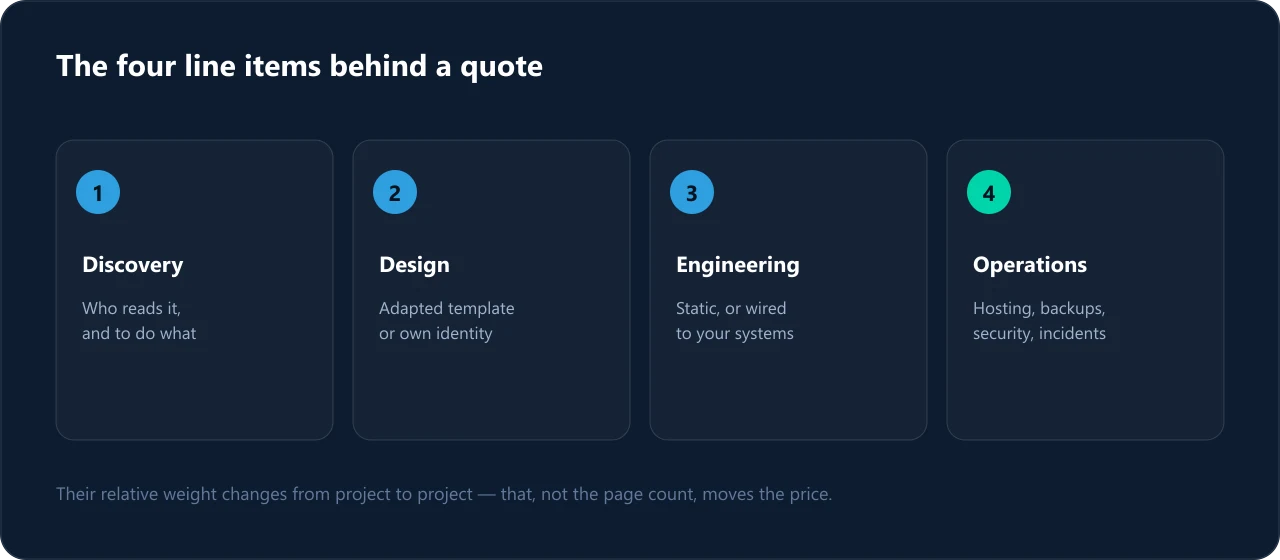
1. Discovery, before the first line of code
How many pages? Who reads them? What must they trigger? An eight-page corporate site for a consultancy and an order-tracking platform wired into an ERP do not require the same preparatory work, even with the same screen count. This is the line item the cheapest quotes cut first — and the one whose absence costs most, in successive rebuilds.
2. Design
A purchased theme, adapted, costs a fraction of an identity designed for you. Both are legitimate choices. The theme has one underestimated flaw: your competitors may have bought the same one, and your prospects stop telling you apart.
3. Engineering
A site whose content only changes at each release is quick to build. The moment you need a client area, payments, a catalogue synchronised with stock, or an integration with an existing system, you change category. Every connection to a third-party system is a project inside the project — and it is almost always the other side's API that sets the schedule.
4. Operations
Hosting, domain, certificate, backups, security updates, incident response. A quote that mentions none of this is not cheaper: it is incomplete.
Ranges, and what they cover
| Project type | What it covers | Order of magnitude |
|---|---|---|
| Corporate site | 6 to 10 pages, contact form, technical SEO, responsive, analytics | A few thousand euros |
| Editorial site | The above, plus a publishing back office and a media library | Roughly double |
| Online commerce | Catalogue, cart, payments, order management, logistics integration | Several tens of thousands of euros |
| Business application | Accounts, roles, data specific to your operation, integrations | Priced after discovery, never before |
These are not price lists. They place a request: if your need looks like the third row and the quote you received matches the first, one of the two is wrong.
Five questions to ask before signing
- Who owns the code? If the answer is not “you”, changing vendor means starting over.
- Where will it be hosted, and who owns the account? A domain registered in the agency's name is leverage against you the day you disagree.
- What can I change without calling? A site where every price update needs a billed intervention is expensive over time.
- What happens if something breaks on a Saturday? The response time belongs in writing.
- What is not included? The right answer is a list, not silence.
The cheapest-quote trap
A low-price site is almost always a site without discovery, without maintenance, and often without transfer of ownership. It works on delivery day. Six months later the framework is out of date, the contact form has been silently failing for a week, and whoever built it stops answering. Recovery then costs more than doing it properly from the start, because you first have to understand and then dismantle what exists.
The right measure is not the quoted amount, it is total cost over three years — build, hosting, fixes, and the time your own teams will spend on it.
What genuinely reduces the bill
- Cut the scope of version one. Ten pages that convert, then additions, costs less than shipping everything at once — and teaches you what you actually need.
- Supply your own content. Copy, photography, translation: producing them is a real share of the budget when delegated.
- Decide quickly. Rounds of feedback on a shade of blue are billed at the same rate as engineering.
How we price
We start from the outcome, not the page count. A short discovery says what is necessary, what can wait, and what will never be used. The resulting quote itemises every line, states what is not included, and leaves you owning the code and the accounts.
Our online estimator gives a range in a few questions, and the Web & Mobile Development page details the method. For a real figure, write to us: the scoping conversation is free, and you leave with a range even if the project goes elsewhere.

ROCH Technologie
We design and build web, mobile and business platforms for companies that want a technical partner, not an order-taker.
Read next
Outsourcing development: the six questions that decide the outcome
Outsourcing development almost never fails on the technical side. It fails on ownership, visibility and exit — three things settled before signing.
5 min readSelling into West Africa: what your platform must handle
A platform designed for Europe fails on three precise points in West Africa. None are technical: they are contractual decisions.
6 min readGDPR: what your site collects without you knowing
A contact form, an analytics tag and a share button are enough to trigger obligations. The whole question, in plain terms.
5 min read